Adoption starts
before the technology.
You can switch AI on for your whole organization today. Whether your people do better work because of it a year from now depends on what happens before that: whether they understand what is changing in their work, and whether they learn to work together with AI instead of only using her. That is where we start.
The organizations that win the AI transition are not the ones with the best technology, but the ones that know how to bring out their people's strengths and keep them there.
We guide boards, teams and organizations through the AI transition, from the first conversation to a way of working that lasts.
“Not technology but why, and that gives a good foundation.”
From 160 evaluations at an organization in the financial sector, as of November 24, 2026. Quote translated from Dutch. Read how that program runs.
 Watch our item in De AI Storm on RTL 7 (in Dutch)
Four phases. One direction.
Most organizations already work with AI, some further along than others. So where the program starts and at what level, we decide together. Then it runs in four phases, each producing something you can build on. After each phase we measure whether the program is still on track for the right result, and we adjust planning, approach and focus together. Management and Governance run alongside the whole way.
Phase 1 · see
Spark
A ninety-minute conversation with twenty people at most: why would we want this, when do we use AI, and what does it give us, at work and at home too.
Read more about Spark →Phase 2 · do it yourself
Play
People learn to work together with AI, in a game and in training, and at the end hand in something from their own work.
Read more about Play →Phase 3 · build
Create
The ideas from your own organization become use cases with a light business case. Your own committee chooses, and the final shows working proof.
Read more about Create →Phase 4 · embed
Deliver
Validate, experiment, scale and embed, with two names per use case and an end date for the old way of working. With the Lab you run the next round yourselves.
Read more about Deliver →Parallel track · lead
Management
For boards and management: do you choose based on the technology, or based on the impact on your organization?
Read more about Management →Parallel track · stand behind it
Governance
From the first yes: what may be done with which data, who decides, and may you scale. So you can explain what you do with AI.
Read more about Governance →Hover over a phase or a track, or click it. See our services in detail →
AI changes what is possible.The core of everything we do
People decide what matters.
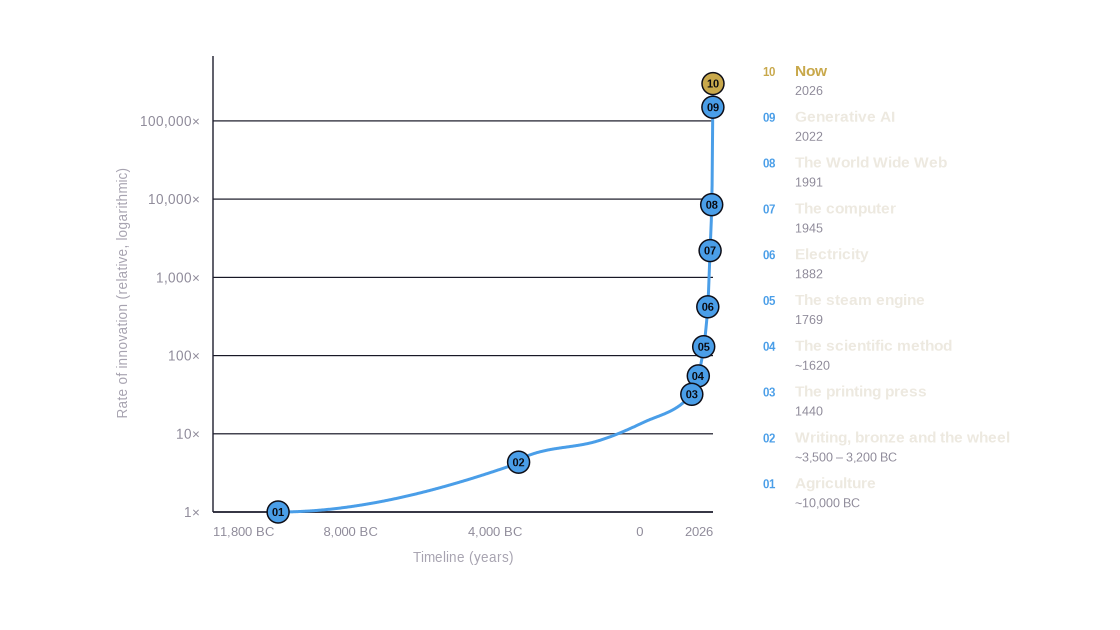
From linear to exponential to hyper-exponential
The agricultural revolution took thousands of years, the industrial one a century and a half. The computing power behind AI now doubles every five months. People and organizations do not, and every organization has to deal with that difference.source
What is left of the work?
As AI takes over more of the how and the what, people are left with the when and the why. For someone who is good at their job, that first raises a question: what is left of my work, and which part do I not want to lose? The answer depends on how they learn to work with AI. Treat her as the next tool and you learn to prompt, and that is where it stops. Get to know her as a partner, with what she can do and where she gets it wrong, and you decide for yourself what you hand over and what you keep.
Sharp on AI. Careful with your people.
With open eyes
We are not evangelists who claim AI solves everything, and not doomsayers who predict the end of work. We look hard at what AI means for people, and build from there.
You can see what it produces
Each phase ends with something you can show, from work people made with AI themselves to applications that are in use. You get a clear direction from us, without thick readiness scans and AI strategy documents.
The quiet cost of an unguided transition
What a transition costs in money and time is in the plan. What it costs in culture, and in knowledge that was never written down, is not, and it disappears without anyone noticing. We make it count from the first decision.
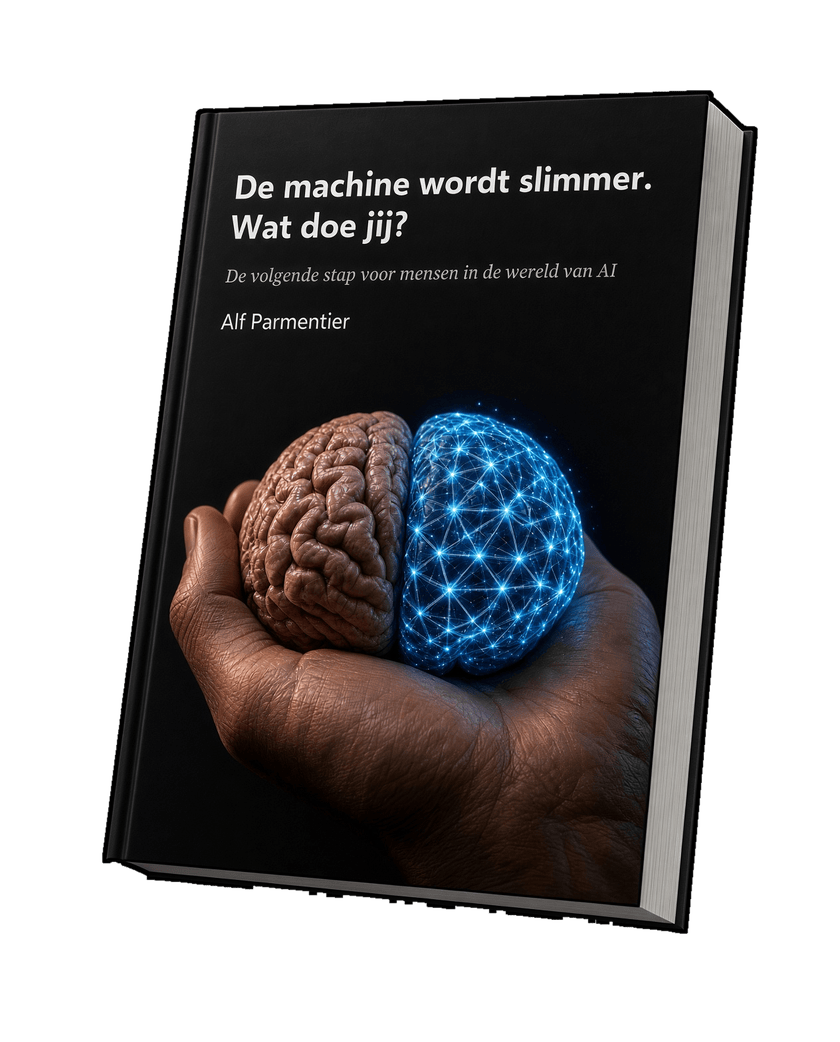
The machine is getting smarter. What about you?
That is also the title of Alf Parmentier's book, available as a paperback and an e-book, in Dutch.
The question is what is left of your organization when you come out the other side.
We guide your people so that they lead the transition instead of enduring it.
Let's meet